


In the previous article, I revisited the rubber glove analogy to explain an important concept.
Specifically, I discussed what happens when procedures that are the opposite of lifting—that is, surgeries that reduce facial volume—are performed.
These include facial contouring procedures (such as cheekbone reduction, square jaw reduction, and chin surgery) and facial liposuction (targeting the anterior cheeks, nasolabial area, buccal fat region, and double chin).
After these procedures, patients can sometimes experience excess skin and facial sagging as a result of the reduced underlying volume.
That was the focus of the discussion in the last post.
Nevertheless, because of what I call the “second characteristic of the skin,” I explained that these kinds of procedures can still be performed safely.
The second characteristic I mentioned was this: the skin shrinks twice.
Today, I would like to take some time to explain what this means.
Let me go back to my time at the university hospital.
During my training there, most of the procedures I performed in the Department of Plastic Surgery were what we call soft tissue surgery– operations that involve the soft tissues of the face, excluding the bones.
(What we often call “soft contouring surgery”—the word “soft” comes from “soft tissue,” which refers to those non-bony tissues.)
Large wounds, such as those caused by traffic accidents or burn injuries, or those that occur after tumor or cancer removal,are sometimes too extensive to heal completely through the body’s natural healing ability alone.
When a wound is too large to heal through natural recovery alone, there are several types of soft tissue reconstructive procedures that can help restore the defect.
One of them is skin grafting. In this procedure, healthy skin is harvested from another area of the patient’s own body and placed over the area where the skin has been lost.
Because the skin comes from the patient’s own body, it goes through a process called “graft take”—during which the transplanted skin attaches to the wound site and begins to function again as normal skin.
The university hospital’s Department of Plastic Surgery, this was a procedure we performed several times a day. So typically, the first step in skin grafting is to harvest skin from an area that can be easily concealed by clothing such as underwear or pants.
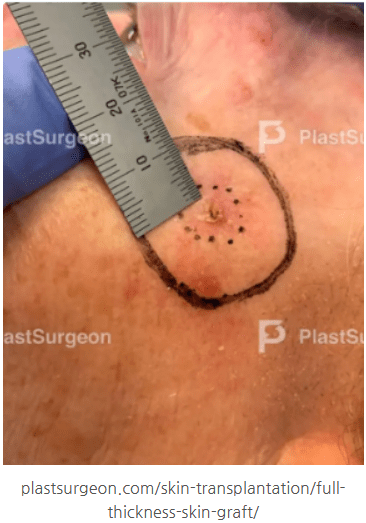
There was once a patient who was diagnosed with a bean-sized skin cancer on the preauricular cheek area. (Since I don’t have the patient’s actual photo,I will show a similar example from an academic image.)

The case looked very similar to this example.
In cases like this, we have to consider the possibility that the cancer may have spread beyond what is visible to the naked eye. So the tumor is usually excised with a wider margin than the size seen on the skin surface.
As a result, there was a skin defect about the size of a quarter after the excision.

The professor who was performing the surgery was planning to harvest a much larger piece of skin than I expected. The wound itself was only about the size of a quarter, but the area of skin he was preparing to harvest was much larger than a half-dollar coin.

I thought it was unusual, but the professor was quite intimidating… lol
So I just quietly assisted without saying anything.
Then, as soon as that half-dollar–sized piece of skin was harvested, something interesting happened. Just like a stretched rubber band snapping back, or like a squid shrinking when it’s placed on a hot grill, the harvested skin began to contract immediately.
As a result, the graft actually shrunk to nearly the point where it almost seemed slightly too small to cover a quarter-sized defect. The surgery was completed very nicely and successfully, and I remember thinking it was a good thing I had just stayed quiet and assisted.
At that time, as I reviewed textbooks and the literature,I learned about what I call the second characteristic of the skin. While studying, I even discovered that the skin does not shrink just once—it actually shrinks twice. This phenomenon is known as primary and secondary contraction. Let’s ask ChatGPT.

As you can see in the skin-harvesting video above, the moment the skin is removed,
it immediately contracts. As soon as the incision is made, the tension that had been stretching the skin is released, and the skin’s rubber-like intrinsic elasticity causes it to shrink. This is called primary contraction.
(Secondary contraction is also an important characteristic, but I’ll write about that in a separate post later—since this is already getting a bit long.)
For now, to explain it briefly: in other words, if the hand becomes smaller to some extent, the glove around it will also shrink accordingly, almost immediately.
It’s like when you buy rubber gloves— unlike shoes, you don’t choose very precise sizes like 240, 245, 250, or 255. Instead, you usually just pick S, M, or L, and as long as they fall within a reasonable range, they still fit comfortably and work well.

So if a hand wearing a rubber glove looks too large and not aesthetically balanced, even if the size of the hand is reduced slightly, the glove will shrink along with it and still fit properly.
In the same way, after facial contouring surgery or facial liposuction, the skin can also shrink and adapt to the new underlying structure.
But then, why is it that people who have undergone these procedures often say that facelift surgery works even better afterward? (After all, that was the starting point of this article.)
If what we discussed is true, shouldn’t the skin adapt on its own without leaving excess skin or causing sagging, even after procedures like facial contouring or liposuction?
By now, you may already have a sense of why this happens. I’ll continue this discussion in the next post.