

In the previous post,
I introduced a fundamental principle of surgery:
“Operate on the area where you want to see improvement.”
While explaining this principle,
I also pointed out something rather unusual about the procedure called a facelift.
And I gave an example of an intuitive wrinkle-removal approach that follows this principle.
Let me bring that example back again.

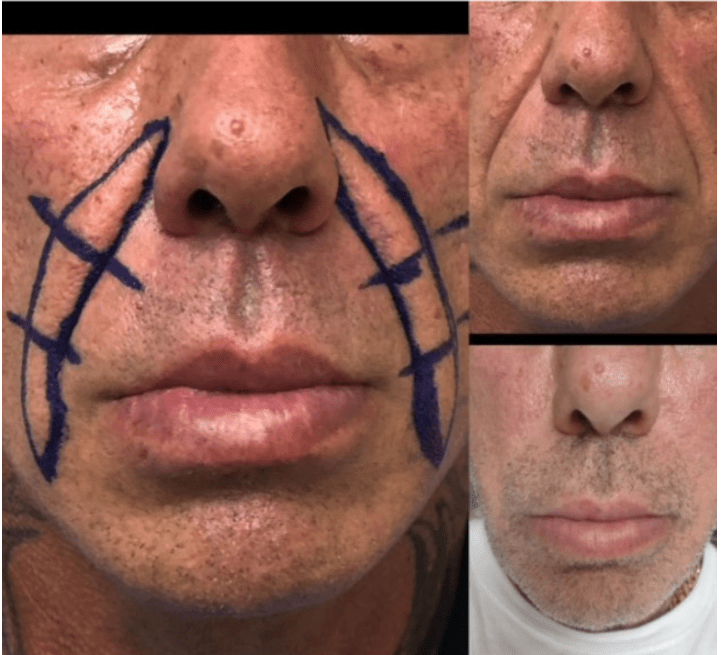
The upper right image shows the preoperative state,
and the lower right image shows the postoperative result.
On the left side, you can see a preoperative drawing that estimates
how much of the nasolabial fold would be removed during surgery.
Now, this is the question I raised in the previous post.
If a direct procedure like this
is more effective and takes less time,
Then why don’t we perform this kind of surgery?
Why do surgeons instead make an incision near the ear,
and operate on the nasolabial folds or the corners of the mouth from there?
The answer is simple.
Because we must avoid visible scars.
More precisely,
even if we successfully remove the sagging tissue,
if a long scar remains next to the mouth or beside the nose
that clearly says,
“I had surgery,”
Would people really say the result looks natural and beautiful?
This type of procedure is more selectively considered in patients whose skin tends to form less conspicuous scars.
That is why we hide the incision
within the natural shadows and contours around the ear cartilage,
and begin the surgery from a point far away near the ear.
But then what about the fundamental surgical principle I mentioned earlier—
“Operate on the area where you want to see improvement”?
Even if the surgery starts in front of the ear,
it simply needs to reach the area where improvement is needed.
In other words,
we enter through the front of the ear (the entrance),
then proceed downward like creating a tunnel,
until we arrive at the nasolabial folds and the corners of the mouth (the destination).

But is this really easy to do?
As I mentioned in the previous post,
if you want to augment the nose, but instead create an entry point through the eyelid to get there, the surgery would not only be technically difficult,
the result would likely turn out uneven and unnatural as well.
In the same way, a facelift also requires traveling a considerable distance
to reach the target area.
Because of this,
the procedure takes more time, and the surgeon must carefully navigate around important structures that must not be injured along the way.
As a result, a high level of surgical experience and skill is required.

People in the past, and even more recently,
found this to be quite difficult.
So instead,they first tried easier methods.
Do you remember the tape I mentioned in the previous post?

“If it’s difficult to reach the front of the face,
why not just hook onto the sagging area and pull it upward?”
“If going all the way from the front of the ear to the nasolabial folds is too demanding, why not lift somewhere around the lateral cheek instead?
After all, the face is connected as a whole—
wouldn’t the front of the face be lifted as well?”
Methods based on this idea were known in the past as the MACS lift,
and more recently, have been widely performed under the name of the mini facelift.

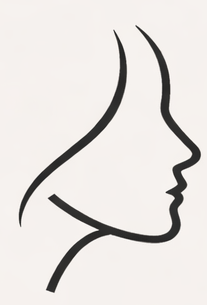
As shown in the illustration,
instead of operating on the front of the face,
the idea was to work only on the lateral cheek area (the gray-shaded region)
and lift that part upward,
With the expectation that the front of the face would also be lifted along with it.
It sounds quite convincing, doesn’t it?
And since the more delicate anterior part of the face was not directly touched,
patients experienced less discomfort as well.
In fact, this procedure was widely performed in the past, and it is still performed today.
However, over time, among patients who underwent surgery using this method,
serious problems began to appear gradually.
What kinds of problems developed?
I’ll continue in the next post.