


Hello,
I’m Dr. Jaewon Heo, a board-certified plastic surgeon in Korea specializing in facelift surgery and facial rejuvenation. My focus is creating natural, youthful results through personalized facelift procedures tailored to each patient’s unique facial anatomy.
As I begin this blog and try to put my thoughts into writing for the first time,
I have to admit it feels a bit overwhelming.
Standing in what feels like an endless ocean of content,
I can’t help but wonder…
Even if I speak out here,
will anyone really be listening?
It’s a thought that lingers as I take this first step.

And yet, despite all that,
there are things I’ve come to understand after all these years of performing facial rejuvenation procedures.
And I keep thinking,
“Maybe someone out there is searching for these very answers,
somewhere in this vast ocean of information.”
So with that small sense of hope,
I’ve decided to begin like placing a letter in a glass bottle
and setting it adrift across the sea.
A bit old-fashioned, I know:D

As for the topics,
I plan to simply write about whatever comes to mind.
And recently, after performing many facelift procedures,
there’s one idea I keep coming back to:
“A facelift is not simply about pulling the face upward.”
Now, if you’re not even entirely sure what a facelift is,
hearing that it’s not about pulling the face upward might sound confusing.
You might be thinking,
“Wait… what does that even mean?”
It may feel like the beginning and the end of that sentence don’t quite match.
So instead of “facelift,”
let me use a more familiar term:
“Lifting.”
“Lifting is not just about pulling.”
Still doesn’t quite click, right?
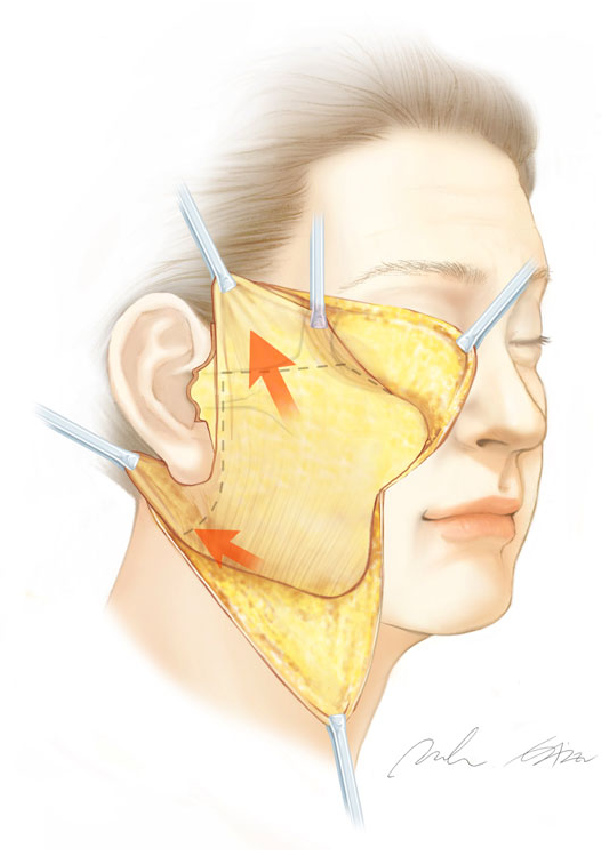
Let me show you an image.

This image comes from a well-known facelift paper by Dr. Min-Hee Ryu.
You may not be entirely sure what specific tissue is being lifted in the image,
but most people will still get the general impression:
“Ah… so this surgery is about pulling that yellowish layer upward.”
And that’s exactly how a facelift is commonly understood.
In simple terms,
the basic concept of a traditional facelift—and even what many people think of as modern “lifting” is:
to pull the sagging parts of the face upward.
Now, here’s something important.
What we perceive as “sagging” is usually located on the front of the face.
Things like hollowed nasolabial folds,
or the wrinkled, folded skin gathering below the corners of the mouth—
These are all features
that we notice on the front of the face.

In other words,
when you look in the mirror after a while and think,
“Why does my face look saggier these days?”
the areas you’re reacting to
are almost always located on the front-facing part of your face.

You might find yourself thinking,
“If it could just be lifted this much, it would look so much better…”
I’m sure many of you have tried this at home.
Standing in front of the mirror and gently lifting your face with your hands.
“If I could just pull it up this little bit, it would disappear…”
“Isn’t there a way to lift it just like this?”
“I don’t need much—just this much would be enough.”
In clinic, I often see patients looking into the mirror,
showing me exactly what they mean and saying,
“Doctor, I just want this much lift.”
And when I hear that, I can almost tell they’ve probably repeated that same motion
at least ten times at home. 😀
And honestly, it makes sense.
The literature we learn from often illustrates tissues being lifted . When you try it yourself, it seems like just a small upward pull would fix it.
So naturally, the idea forms:
“A facelift or lifting is a procedure that pulls the face.”
And that’s the perception most people have today.
But in the next post,
I’ll explain why, as a surgeon who specializes in facelifts and facial rejuvenation,
simply “pulling” the face is not the answer
and why, in fact, it can sometimes lead to unnatural results.