


Hello,
In my previous post, I shared a photo of Marc Jacobs receiving hyperbaric oxygen therapy after his facelift. Seeing that photo made me think that some of you might also be curious about this treatment.
I imagine that many of you may not be familiar with hyperbaric oxygen therapy itself.

During my residency training at a university hospital, I treated a large number of trauma patients. I repositioned fractured facial bones, repaired torn skin, and cared for diabetic foot wounds that were slow to heal, waiting for healthy tissue to gradually fill in.
One of the treatments we used very frequently in those cases was hyperbaric oxygen therapy, or HBOT. I often saw patients whose recovery after surgery had been slow, whose skin had begun to turn dark from tissue necrosis, or whose wounds simply would not heal show noticeable improvement after oxygen therapy.
At the time, I remember thinking, “Why does this work so well?”
But rather than questioning the mechanism in depth, I simply assumed that supplying the body with more oxygen must naturally be beneficial.
Since facelift surgery is the main focus of my practice, I wanted to introduce the research on hyperbaric oxygen therapy after facelift surgery.
I was able to find two relevant studies—surprisingly, there were only two.
So, what did these studies find?

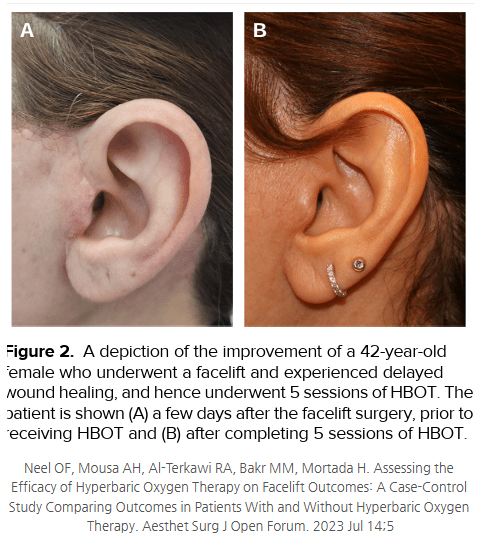
According to a study conducted at a plastic surgery clinic between 2019 and 2022, patients who received hyperbaric oxygen therapy after facelift surgery recovered in an average of 13.3 days.
In contrast, patients who received standard postoperative care alone took an average of 36.9 days to recover.

In addition, no serious complications such as skin necrosis or infection were reported.
Patient satisfaction was also high, with many patients saying that they slept better and that their swelling resolved more quickly.
That said, I personally find the figure of 36.9 days somewhat difficult to interpret, as recovery after an uncomplicated facelift does not usually take that long.
So rather than focusing too much on the exact number, I think the study is best understood as showing that recovery was meaningfully faster in the hyperbaric oxygen therapy group.

Another study published in 2010 examined how quickly bruising faded by using digital color analysis of postoperative photographs.
Compared with the control group, patients who received hyperbaric oxygen therapy had 35% less bruising on postoperative day 7 and 30% less bruising on day 10.
In other words, the difference was large enough for patients to genuinely notice a shorter recovery period.
Personally, based on both my experience during residency and what I have observed in my current practice, I do believe that hyperbaric oxygen therapy has a clear benefit.
Swelling, bruising, and pain—the difficulties we commonly associate with the recovery process—often appeared to improve noticeably after HBOT.
Of course, it is not a magical treatment that works equally well for every patient. There is still no established standard protocol, and large-scale studies remain limited.
Even so, based on the clinical experience of many plastic surgeons who use this treatment, the benefits often seem quite clear.
That is why I was surprised to find so few published studies on the subject.
It even made me wonder, “If the benefits are this noticeable, why are there only two published studies?”
From the perspective of a surgeon who performs these procedures and follows patients throughout their recovery, the potential of this treatment seems very promising.
Hyperbaric oxygen therapy is already an appealing treatment in itself, but when combined with technologies such as AI and image analysis, it may allow for even more precise and personalized treatment planning.
There are still several practical barriers, including the cost of treatment and the time required for each session.
Nevertheless, because HBOT may become an important tool for supporting patients through the recovery process, it is a subject I would like to explore further in the future.
When I have the opportunity, I hope to revisit this topic with actual clinical case photographs.
That brings today’s post to a close. I’ll be back next time with another topic.